Thursday, January 29, 2026
Home Blog Page 18

LHC upholds dismissal of Jhang official for harassing female teacher

0

The Lahore High Court on Tuesday upheld the dismissal of Umer Shahzad, a former director management at the Government Girls Vocational Institute in Jhang, for harassing a female teacher.

Justice Raheel Kamran rejected Shahzad’s petition seeking reinstatement in a 17-page written judgement. The ruling also set a legal precedent, holding that workplace harassment is not confined to office buildings alone.

The case stemmed from a complaint filed by Mehwish Riaz before the Ombudsperson Punjab. Riaz said she was serving as an ad hoc teacher at the institute when Shahzad harassed her.

She told the Ombudsperson that Shahzad looked at her inappropriately and sent her messages to establish illicit relations. According to Riaz, Shahzad claimed he had done her several favours and demanded reciprocation. She said he threatened to cancel her appointment if she refused.

Riaz further stated that in September 2022, Shahzad came to her house and attempted to rape her. She said she managed to call Rescue-15, after which Shahzad fled.

Riaz added that Shahzad continued to threaten her after the incident. She said the threats caused severe mental distress to her and her family.

Shahzad’s lawyer argued that the Provincial Ombudsman could only hear cases where harassment took place at the workplace. He said incidents at a private residence fell outside the Ombudsman’s jurisdiction.

The lawyer also argued that since criminal proceedings were under way, the Ombudsman could not take disciplinary action.

The court rejected both arguments.

Justice Kamran ruled that disciplinary proceedings by the Ombudsman are separate from criminal cases. The court noted that Shahzad did not deny his WhatsApp communication with Riaz.

However, Shahzad claimed the complaint was filed out of personal grudge. He also attempted to question the complainant’s character.

Shahzad alleged that Riaz’s brother worked at the Technical and Vocational Training Authority and had been allotted official housing that was later cancelled.

Justice Kamran ruled that threatening job termination to coerce someone into a relationship amounted to misuse of authority.

He said attempts to malign the complainant’s character could not overshadow Shahzad’s own conduct.

The Ombudsperson Punjab, in a decision dated February 16, 2024, found Shahzad guilty of harassment. The decision cited Section 2(h) of the Protection Against Harassment of Women at the Workplace Act, 2010.

The Ombudsperson ordered Shahzad’s removal from service.

Shahzad appealed the decision before the Governor of Punjab. The governor dismissed the appeal. The Lahore High Court said it found no illegality in either decision.

Justice Kamran also highlighted why many women delay reporting harassment.

“Women often avoid promptly reporting harassment incidents due to fear for their honour, family dignity, and social stigma,” the judgement said.

“Their initial silence, therefore, cannot be construed as a waiver against later seeking redress once they gather the courage to report.”

Maryam warns LHC order suspending property law will help land mafia

0

Punjab Chief Minister Maryam Nawaz on Tuesday strongly criticised the Lahore High Court’s decision to suspend a new property law, warning that it would benefit the land mafia.

She was reacting to an order by LHC Chief Justice Alia Neelum, who on Monday suspended the implementation of the Punjab Property Ownership Ordinance and restored possession of properties seized under it.

The chief justice also recommended forming a full bench to hear objections to the law.

The Punjab Property Ownership Ordinance, passed last month, was aimed at curbing land grabbing across the province.

Under the law, a District Dispute Resolution Committee is set up in each district. It is headed by the deputy commissioner and includes the district police officer, additional deputy commissioner (revenue) and other officials.

The committee can summon records, hold hearings and take immediate administrative steps to protect property.

Complaints are to be decided within 90 days, with a one-time extension of another 90 days subject to approval by the commissioner.

Parties must appear in person. Lawyers are generally not allowed to represent them.

Responding to the suspension of the Punjab Protection of Ownership of Immovable Property Act 2025, Maryam said the law was meant to help millions of citizens.

She said it empowered ordinary people to protect their property through a legal mechanism.

The chief minister argued that the court’s decision was not in line with principles laid down by the higher judiciary.

She warned that suspending the law would benefit land mafia and could be seen by the public as support for illegal elements.

“The law was not enacted for my personal benefit, and its suspension does not affect me personally, but it severely harms ordinary citizens, widows, the destitute, and the oppressed, who were meant to gain protection,” she said.

During Monday’s hearing, Chief Justice Neelum questioned how a revenue officer could enforce possession while a case was pending before a civil court.

The court said the move effectively nullified civil rights and undermined judicial authority.

The chief justice also noted that the law barred the high court from issuing a stay in such matters.

“You call someone on the phone and say, ‘Come, or your property is gone,’” she said. “You stand here while your house is being taken?”

She further raised concerns about safeguards in the law, questioning whether fake registrations and forged documents were being used.

The chief justice emphasised that only the complainant should act as the petitioner in such cases and said the issue required deeper judicial scrutiny.

Islamabad court orders Airblue to pay Rs5.41b in damages over 2010 crash

0

An Islamabad court has ordered Pakistani airline Airblue to pay 5.41 billion rupees ($19.5 million) in compensation to victims of a 2010 plane crash, rejecting all appeals filed by the carrier, court officials said.

The ruling was issued by Islamabad’s District and Sessions Court. It dismissed eight appeals submitted by Airblue and imposed a fine of 1 million rupees on each appeal, bringing the total fine to 8 million rupees.

The court said the compensation was payable to families and individuals affected by the crash, which killed several passengers when an Airblue aircraft went down near Islamabad in July 2010.

According to the verdict, the compensation will be paid as follows:

  • Sumera Naveed Choudhry and two others will receive 143.189 million rupees.
  • Rashid Zulfiqar and four others will receive 630.94 million rupees.
  • Muhammad Ilyas will receive 1.101 billion rupees.
  • Gohar Rehman will receive 507.348 million rupees.
  • Junaiduz Zaman Hamid will receive 996.048 million rupees.
  • Muhammad Javed Khan will receive 857.025 million rupees.
  • Mst. Salima Rajput will receive 572.666 million rupees.

Retired Colonel Shamim Akhtar will receive 606 million rupees.

The ruling stems from a civil claim filed against Airblue over its role in the 2010 crash. Families of the victims had challenged an earlier decision by a civil judge, who awarded partial compensation of up to 10 million rupees per person.

In its decision, the court criticised Airblue for repeatedly filing appeals. It said the airline had wasted judicial time by contesting the compensation awarded to victims.

Airblue’s lawyers had argued against the compensation amounts but failed to convince the court.

Appeals filed by the victims are still pending before the Islamabad High Court. The High Court had earlier transferred jurisdiction of the case back to the District and Sessions Court for a final decision.

Gunmen kill five policemen in KP ambush

0

Five police officers were martyred on Tuesday when gunmen opened fire on a police vehicle in Pakistan’s northwest Khyber Pakhtunkhwa province, officials said.

The attackers set the vehicle ablaze after shooting at it in Karak district, police said. The officers were on duty when the ambush took place.

Police identified the slain officers as Shahid Iqbal, Safdar, Arif, Samiullah and Muhammad Abrar.

The attack occurred near Aman Kot in the Garagri Banda area. The mountainous region lies along the boundary between Karak, Kohat and Lakki Marwat districts and is considered highly sensitive because of oil and gas reserves.

After the attack, police sealed off the area and launched a search operation. Investigators collected evidence from the scene and opened a formal inquiry.

“We are investigating the incident from all angles and efforts are underway to trace the attackers,” said Saud, the district police officer in Karak.

Oil and gas from Garagri Banda are supplied to several southern districts of the province, including Bannu, Dera Ismail Khan and Lakki Marwat, as well as Bhakkar. MOL Pakistan operates extraction in the area, with security provided by the Pakistan Army and other law enforcement agencies.

The region has a history of militant violence. In the past, armed groups have attacked oil and gas installations, and workers at some sites have been kidnapped.

Prime Minister Shehbaz Sharif strongly condemned the attack and expressed grief over the deaths.

“The police have always played a frontline role in the fight against terrorism,” Sharif said. “The entire nation salutes the martyrs.”

Khyber Pakhtunkhwa Chief Minister Sohail Afridi also condemned the ambush.

“The sacrifices of the police personnel will not go in vain. The provincial government stands with the police,” Afridi said.

The killings are the latest in a string of attacks targeting police in the province.

Last week, a police officer and his brother were shot dead in Lakki Marwat. Earlier this month, one officer was killed and five others wounded in a suicide bombing that hit a police vehicle in the same district.

In November, three police officers were killed while responding to a militant attack on a checkpoint in Hangu district.

Shehbaz open to talks with PTI but rejects ‘illegal demands or blackmail’

0

Prime Minister Shehbaz Sharif on Tuesday said the government was open to dialogue with Pakistan Tehreek-e-Insaf but would not accept what he called “illegal demands or blackmail.”

He made the remarks while speaking at a federal cabinet meeting in Islamabad.

“These days, PTI and its allies are talking about dialogue. I have repeatedly stated in the National Assembly that if PTI is serious about negotiations, the government is equally prepared,” the prime minister said.

However, Shehbaz said talks could only move forward if they focused on “legitimate issues.”

He stressed that political harmony among all parties was essential for Pakistan’s development and prosperity.

Meanwhile, Aleema Khan, sister of PTI founder Imran Khan, has rejected the idea of dialogue from the party’s side.

Speaking to reporters outside the Rawalpindi anti-terrorism court a day earlier, she said any party leader advocating talks was neither aligned with Imran Khan nor with PTI.

She also said she was unaware of the communiqué issued after a two-day conference of the Pakistan Constitution Protection Movement and had not been formally informed about it.

On Monday, the opposition alliance released a joint declaration after two days of meetings in Islamabad.

The declaration included demands for a probe into the February 24 general elections and called for dialogue with the government.

Reacting to the opposition’s demands, Federal Minister for Parliamentary Affairs Dr Tariq Fazal Chaudhry of the Pakistan Muslim League-Nawaz said the government was not opposed to dialogue.

The Pakistan Peoples Party, a key coalition partner in the federal government, also supported talks but with conditions.

PPP Secretary Nayyer Bukhari told The Express Tribune that dialogue would only be meaningful if confidence-building measures were taken.

“They want dialogue with some other quarters,” he said.

“The question is not whether the financial system can afford to support this transition, but whether the country can afford continued inaction,” the report concludes. “With billions in deposits seeking productive deployment and millions of households seeking affordable energy solutions, the ingredients for transformation exist.” The event concluded with the launch of the Pakistan Energy Finance Network, a practitioner-led platform aimed at bridging energy policy ambitions with financial market realities.

0

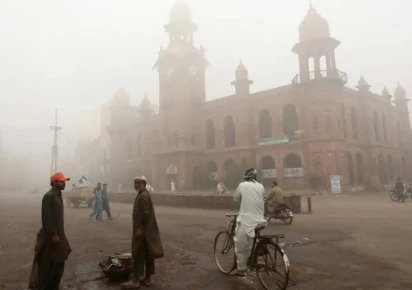
Smog continued to blanket large parts of Punjab on Monday, pushing air quality in several cities to unhealthy and hazardous levels and placing Lahore among the world’s most polluted major cities, according to official and real-time monitoring data.

The provincial Environmental Protection Agency (EPA) reported an average Air Quality Index (AQI) of 198 across Punjab during the day, a level classified as unhealthy for sensitive groups.

Lahore emerged as the most polluted district in the province, with an average AQI of 375 between 8:00am and 3:00pm, falling into the very unhealthy category.

City-level readings showed extreme pollution hotspots across Lahore. AQI levels reached as high as 565 at the University of Engineering and Technology (UET), followed by 427 at the EPA headquarters and 420 near Town Hall. Other heavily affected areas included the Lahore Waste Management Company zone, Safari Park, Punjab University, and several hospital localities, underscoring the widespread nature of the smog episode.

The deteriorating air quality placed Lahore second on the global list of most polluted major cities, with an AQI of 366, according to international live air quality rankings. Delhi topped the list with an AQI of 555, while Dhaka, Kolkata and Bishkek followed Lahore, highlighting a broader regional pollution pattern across South and Central Asia.

Other cities in Punjab also recorded unhealthy air. Rahim Yar Khan, Faisalabad, Bahawalpur, Narowal and Gujranwala posted AQI readings well above 200, while Gujrat and Khanewal remained unhealthy for sensitive groups Even cities at the lower end of the provincial ranking, including Rawalpindi, Sargodha and Multan, failed to return to safe air quality levels. Environmental experts attribute the persistent smog to a combination of vehicular emissions, industrial pollution, crop residue burning and unfavourable weather conditions.

Dense fog, reported across large parts of Punjab and upper Sindh, trapped pollutants near ground level, worsening breathing conditions.

Meanwhile, the Pakistan Meteorological Department said a westerly weather system was affecting northern parts of the country. Intermittent rain and snowfall were forecast for Gilgit-Baltistan, upper Khyber-Pakhtunkhwa and Kashmir, while cold and dry conditions were expected to prevail across most plains, offering little immediate relief from smog.

Meteorologists warned that moderate to dense fog would likely continue over Punjab’s plains over the next two days, potentially prolonging hazardous air quality.

Solar financing gaps in market prevent access to $2.8billion

0

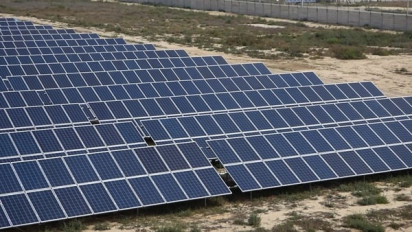
Pakistan’s distributed solar market holds an estimated Rs800 billion ($2.8 billion) in untapped lending potential across just three major cities, yet millions of households and small businesses remain excluded due to structural financing constraints, according to a study launched on Monday by Renewables First.

Despite rapid growth in solar adoption across the country, the study finds that the benefits have accrued disproportionately to affluent households and large enterprises that are able to self-finance installations. In contrast, Pakistan’s banking sector, which holds about $131 billion in deposits, channels only $50 billion into lending, with nearly 63% of banking assets invested in government securities rather than productive sectors of the economy.

The study was conducted in knowledge partnership with the Pakistan Banks’ Association (PBA), the National Institute of Banking & Finance (NIBAF) and the Karachi School of Business & Leadership (KSBL), and was unveiled at a ceremony held at a local hotel in Karachi.

“The problem isn’t actual risk, it’s perceived risk,” said Naveen Ahmed, climate finance expert and co-author of the study. He said that banks were missing viable business opportunities because internal systems and risk frameworks had not kept pace with market realities.

The report highlights a sharp paradox in Pakistan’s energy and finance landscape. While electricity tariffs have risen by more than 200% since 2012, the cost of solar panels has declined by 73% since 2017, resulting in payback periods of less than two years in many cases. Despite this, households spending up to 20% of their income on electricity and small and medium enterprises (SMEs) burdened by high energy costs remain excluded from solar financing due to rigid collateral requirements that prioritise asset ownership over cash-flow viability.

Among the key findings, the study notes that banks operate at an advances-to-deposits ratio of below 40%, while often demanding double collateralisation for solar loans. It also finds that distributed solar portfolios show default rates of below 2%, compared to over 10% for traditional SME lending.

“This represents a missing middle segment, enterprises and households that are too large for microfinance but too small or informal for commercial banks,” said Shezad Abdullah, a banker and co-author of the study.

Panelists at the launch stressed that unlocking this opportunity requires improved market segmentation and tailored product design rather than blanket risk aversion. Ammar Habib Khan, chief executive officer of the National Credit Guarantee Company Limited (NCGCL), said that before scaling up financing, it was essential to identify eligible consumer and enterprise segments, understand their risk profiles and design instruments accordingly.

Similarly, PBA Managing Director Nejib Rehman said banks were not fundamentally opposed to solar lending. However, he noted that concerns around repayment consistency, property ownership, particularly in apartment buildings, limited historical data and regulatory uncertainty continued to influence lending decisions.

The study proposes several market-ready financing models to bridge the gap, including anchor-based financing, vendor-linked financing, on-lending models through development finance institutions and microfinance providers, and securitisation of solar loan portfolios to unlock liquidity.

“Pakistan lacks credit bureaus covering informal borrowers, standardised documentation for small-ticket loans and efficient dispute resolution mechanisms,” said Ummamah Shah, senior associate for energy finance at Renewables First.

Looking ahead, panelists also pointed to battery energy storage systems as the next phase of innovation, building on the momentum of distributed solar.

With Pakistan having imported over 50 gigawatts of solar panels in the past five years, equivalent to the country’s entire grid capacity, the infrastructure exists. What remains missing is the financial intermediation to ensure equitable access.

“The question is not whether the financial system can afford to support this transition, but whether the country can afford continued inaction,” the report concludes. “With billions in deposits seeking productive deployment and millions of households seeking affordable energy solutions, the ingredients for transformation exist.”

The event concluded with the launch of the Pakistan Energy Finance Network, a practitioner-led platform aimed at bridging energy policy ambitions with financial market realities.

Pakistan, Libya clinch multi-billion dollar arms deal

0

Pakistan has reached a major multi-billion dollar conventional arms export deal with Libya, four Pakistani officials told Reuters.

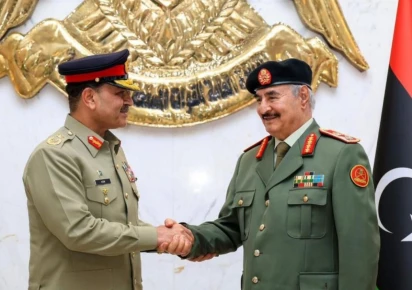
According to Reuters, the deal, described as one of Pakistan’s largest-ever weapons sales, was finalised after a meeting last week between Chief of Army Staff and Chief of Defence Forces Field Marshal Asim Munir and Lt Gen Saddam Khalifa Haftar, Deputy Commander-in-Chief of the Libyan Armed Forces in Benghazi.

The officials, all involved in defence matters, declined to be identified due to the sensitivity surrounding the agreement. Pakistan’s Foreign Office, defence ministry and military did not respond to requests for comment. A copy of the deal seen by Reuters before its finalisation listed the purchase of 16 JF-17 Thunder fighter jets, jointly developed by Pakistan and China, and 12 Super Mushak trainer aircraft used for basic pilot training.

One Pakistani official confirmed the list was accurate, while another said all items mentioned were part of the deal, though exact numbers could not be independently verified. Officials cited by Reuters said the agreement covers equipment for land, sea and air forces and would be implemented over a period of around two-and-a-half years.

The LNA’s official media channel also reported on Sunday that the faction had entered into a defence cooperation pact with Pakistan, including weapons sales, joint training and military manufacturing, without offering further details. Sources confirmed the agreement that would mark a major milestone for Pakistan’s defence exports and place it among a small group of countries capable of concluding multi-billion dollar conventional arm deals.

However, any such agreement with the LNA is expected to attract international scrutiny given Libya’s prolonged instability since the 2011 NATO-backed uprising that toppled Muammar Gaddafi and plunged the country into years of conflict between rival authorities in the east and west.

Libya has technically remained under a UN arms embargo since February 2011, imposed through United Nations Security Council Resolution (UNSCR) 1970 and later reinforced by subsequent resolutions, including UNSCR 1973. The embargo prohibits all states from supplying, selling or transferring arms and related materiel to Libya.

Despite this legal framework, arms flows into Libya have continued largely unabated over the past decade, fuelling proxy conflicts and deepening divisions between rival factions.

Sources told The Express Tribune that Pakistani authorities do not expect the UN embargo to pose a practical obstacle to the reported defence cooperation with Libya, arguing that the embargo has long ceased to function as an effective enforcement mechanism.

According to the sources, the arms embargo exists more as a formal or “paper” restriction rather than a meaningful barrier on the ground. They pointed to persistent violations by multiple regional and international actors over the years, which have effectively hollowed out the embargo’s credibility. The sources noted that Libya’s fragmented governance structure and deep political divisions within the UN Security Council have significantly undermined enforcement.

Monitoring mechanisms rely largely on voluntary compliance by member states and periodic reporting by the UN Panel of Experts, with limited capacity to interdict or penalise violators. Even the European Union’s naval mission, Operation Irini, launched in March 2020 to enforce the arms embargo, has had only marginal impact, the sources said, due to its limited mandate, selective inspections and lack of consensus among EU members on Libya.

Over the years, rival Libyan factions have received extensive military support from external powers. Turkey and Qatar have openly backed the Tripoli-based governments, including the former Government of National Accord (GNA) and its successor, the Government of National Unity (GNU), through the supply of drones, armoured vehicles, air defence systems, military advisors and allied fighters.

The Tripoli authorities have also enjoyed diplomatic recognition and varying degrees of political support from the United States, Britain and Italy. On the opposing side, the eastern-based House of Representatives and the LNA have been supported by the United Arab Emirates, Egypt and Russia, with reports of fighter aircraft, drones, artillery systems, armoured vehicles, intelligence sharing and private military contractors.

France has also faced repeated allegations of covert assistance to the LNA, though Paris has officially denied direct military involvement. Saudi Arabia, Jordan and Chad have likewise been cited in UN reports for providing varying forms of support to eastern Libyan forces.

Sources told The Express Tribune that these sustained and largely unchecked violations have created a permissive environment in which new defence arrangements are unlikely to trigger meaningful punitive action. They added that supplier states have routinely exploited loopholes in the embargo by routing weapons through third countries, classifying shipments as dual-use or civilian equipment, and relying on private military contractors and mercenaries to provide combat capabilities without formal state-to-state transfers.

Financial support, the sources said, has often been disguised as humanitarian or reconstruction assistance, while selective enforcement and weak intelligence sharing among UN members have further reduced the risk of accountability. Against this backdrop, sources believe that the reported defence deal reflects Islamabad’s growing confidence in its indigenous defence industry and its expanding military diplomacy, the sources added.

They argued that Pakistan has made steady progress in recent years in developing competitive defence products, ranging from fighter aircraft and trainer planes to armoured vehicles, naval platforms and precision-guided munitions. Recent military exercises and defence exhibitions, including the Mark-e-Haq series, have showcased these capabilities to foreign delegations.

The sources described the Libya agreement, if fully implemented, as historic in both scale and financial impact, potentially opening new markets for Pakistani defence exports in Africa and the Middle East.

They also credited the outcome to what they termed an export-driven strategic outlook and an emphasis on defence diplomacy, while acknowledging that the deal would continue to be closely watched by international observers amid Libya’s unresolved conflict and fragile political process.


Trump reiterates stopping Pakistan-India war, praises CDF Munir

0

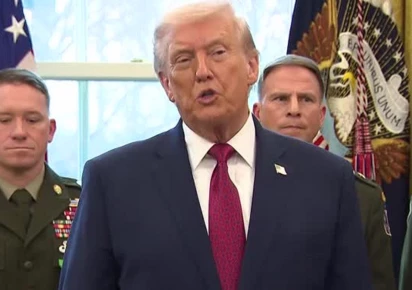
President Donald Trump, in an event at his Mar-a-Lago residence in Florida on Monday, reiterated his claims that he helped prevent a war between Pakistan and India in May 2025. He praised Chief of Defence Forces Field Marshal Syed Asim Munir, calling him a “highly respected general”.

“We stopped a potential nuclear war between Pakistan and India,” Trump said in response to a question, alongside Secretary of Defence Pete Hegseth and Secretary of the Navy John Phelan.

The US president mentioned that Prime Minister Shehbaz Sharif credited him with saving lives through his intervention and mediation.

“You know, eight planes were shot down. That war was starting to rage, and he actually said the other day that President Trump saved 10 million lives, maybe more,” he said.

In the same event, Trump announced plans for a new class of US Navy warships that will be named after himself, a rare honour for a sitting president. The first vessels in the so‑called Trump‑class will be built under a broader initiative he calls the “Golden Fleet.”

Two ships will be built initially, with plans to expand construction further. Officials displayed renderings showing vessels that could be larger and more heavily armed than existing destroyers, equipped with missiles, guns and advanced systems including lasers and hypersonic weapons.

The president also emphasised the advanced nature of US submarines, declaring them the most sophisticated in the world. He confidently stated that the US is at least 15 years ahead of any other nation in submarine technology, a significant advantage that bolsters the country’s military posture.

As part of the US Navy’s modernisation efforts, he revealed that 15 cutting-edge submarines are currently under production, reinforcing the Navy’s dominance globally.

Three bidders compete for PIA’s privatisation, 75% stake

0

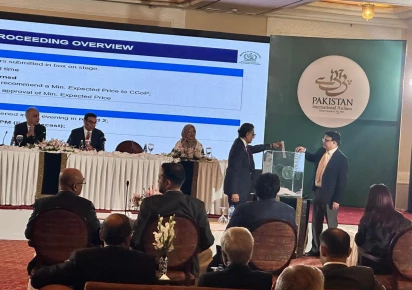
Three bids were submitted Tuesday morning for the 75% stake in Pakistan International Airlines, with the first phase of the bidding process completed as of 11.15am.

“The first phase of the bidding process has been completed; now the matter will go to the Privatisation Commission,” said Privatisation Commission (PC) Chairman Muhammad Ali.

The bids came from pre-certified bidders Lucky Cement, private airline Airblue and investment firm Arif Habib. Fauji Fertiliser, among other bidders, have pulled out of the running. If the bids exceed the reserve price, an open auction will take place. If not, the highest bidder will be allowed to match the price.

The PC has received all bids by the December 22 deadline, and according to Muhammad Ali, the PC board will review and discuss PIA’s reserve price, of which the exact figure remains undisclosed. The government has stated that this privatisation is crucial for the airline’s financial health and aims to inject significant investment to steer the company towards profitability.

Ali emphasised that once the reserve price is approved by the board, it will be forwarded to the Cabinet Committee for final approval.

The PC board meeting is now in progress to determine the reference prices.

“This is a very significant step,” Ali said. “No major privatisation of a national asset has taken place in the last 20 years, making this move historic for Pakistan.”

In a video shared on the Ministry of Privatisation’s X account, Ali states that they will go to the Cabinet Committee on Privatisation (CCoP) to get approval for the reference price.

The session will resume at 3.30pm today. The Cabinet Committee’s approval of the reserve price will be the next major milestone.

Push for privatisation

PIA, which has been operating at a loss for several years, has been a target for privatisation by previous governments. The airline has struggled with mounting debts, outdated fleets, and an inability to keep pace with the competition. Past attempts at privatisation have faced obstacles, but the current administration appears determined to push ahead with this reform.

New investors are required to commit an investment of Rs80 billion over the next five years. Of the proceeds from the sale of 75% of PIA’s shares, 92.5% will be allocated to the airline for reinvestment, while the remaining 7.5% will be transferred to the government.

If any bid exceeds the reserve price, it will be opened. In the event of a lower bid, the highest bidder will be allowed to match the price. Once the successful bidder is identified, the bidder will have 90 days to purchase the remaining 25% of shares. The government had taken responsibility for PIA’s liabilities of Rs 654 billion last year. Routes to England and other parts of Europe have already been restored.

In a move to safeguard PIA’s workforce, the PC has stated that employee job security will be guaranteed for one year. Additionally, the holding company will be responsible for managing pension plans and post-retirement benefits.